12 January 2010

Old News: Zahi Disses Beyonce


(Via Objects-Buildings-Situations)

I'm late to this one, I admit. Back in November, Zahi Hawass and Beyoncé did a photo op at the Pyramids together. He gave her a personal tour and a book about Tutankhamun, but she was insufficiently excited about the honor. So he made some snide comments about her behind her back, as Bossip reports:
In a shocking display of poor diplomacy, Egypt’s chief Egyptologist Zahi Hawass allegedly called American pop-star Beyonce a “stupid person” during her brief tour of the Giza pyramids earlier this week. Writing in al-Shorouk newspaper, Summer al-Gamal said that Hawass became fed up with the pop star’s attitude after she did not show the interest Hawass felt was deserved of the pyramids.
A meeting of great entertainers, for sure, complete with celebrity ego flameouts. Can I get a reality show with Zahi Hawass teaching some pop singers to excavate? We could call it "celebrity archaeology camp." I would pay money to see that for reals.

Besides the amazingness of seeing a photo of these two together, the reception of the event on the blogs is fascinating: his insult to Beyoncé became a segue into discussions of his bad temper and insults toward archaeologists (see here, here, and here). As if Beyoncé was somehow the last straw!

(Bossip)

I wonder if Beyoncé is too busy with her occult rebirth to pay sufficient attention to archaeology?

Thanks to Kostis Kourelis' great blog for clueing me in to the story.

01 January 2010

Hawass Demands Frescos, French Surrender: A Preview of Archaeology in the 2010s

To ring in the new year, a story that hints of things to come in global archaeology, and some prognostications and aspirations for the coming decade.

First to Egypt, where Zahi Hawass has been generating a lot of news in recent months. Fresh off of the Louvre’s return of mosaic fragments stolen from the tomb of Tetaki the head of Egypt’s Supreme Council of Antiquities (SCA) will formally demand the return of the bust of Nefertiti, the Rosetta Stone, the Dendera Zodiac, and other iconic artifacts in European museums.


Hawass: praying for a return? (AFP)

The storyline has been playing out all year. Back in January 2009, German archaeologists informed the SCA that the mosaic fragments in the Louvre were looted, and Egypt promptly demanded their return. Early in October, Egyptian Minister of Culture Farouk Hosni lost a close election for UNESCO Director-General, partly due to the opposition of France. A few days later, on October 7, Egypt gave the Louvre notice that they would not be getting excavation permits for their long-time dig at Saqqara if they did not return the fresco fragments. Though the Louvre management initially met the demand with defiance, it took them only a day and a half to cave. On October 9, the museum agreed to return the fragments to Egypt.

December 14, French President Nicolas Sarkozy formally presented the fragments to Egyptian Prime Minister Hosni Mubarak during his state visit to Paris. (No word on whether cheese was eaten during the surrender.) Egypt exacts a satisfying revenge for its loss at UNESCO, and strikes a blow for the cause of repatriation.


This fine product courtesy of Bob McCarty.

As the press noted in October, the return of the Tetaki frescos was part of Hawass’ larger repatriation vision, which includes both recently looted material and certain iconic artifacts, like the Rosetta Stone and the famous bust of Nefertiti in Berlin, that he believes were removed from Egypt illegally.

While Hawass has been on this topic for years, he apparently has recently changed tactics. After requests for loans of the iconic artifacts were rebuffed by the British Museum and the Neues Museum, he has decided to put his foot down, in typically amusing fashion:
"What angers me is that for decade after decade the museums of the world have treated Egypt like a buffalo, exploiting our generosity by asking to borrow our artefacts for their various exhibitions and we have complied, handing things over for free,'' he said.

''But now the buffalo is thirsty*, and needs attention, but no one cares to help. Well, we have had enough of this. No more. I will not tolerate this kind of treatment any longer.''

This is how Egypt has been treated. Needs a drink now. (Jiri Bohdal)

Next March, Hawass will convene a conference on the return of stolen antiquities which will include up to a dozen states including Italy, Greece, China, and Mexico. Details of the agenda are unclear – I wonder if we’ll see a permanent organization of source states to advocate for repatriation of looted materials? The fact that these countries are major research destinations for American and European archaeologists adds a certain frisson to the proceedings. The possibility of connecting research permits to repatriation is a cloud looming over the heads of the archaeological establishment in the global North.

My guess for the next decade: such meetings are the shape of things to come. While the case for return of the Tetaki frescos was open and shut, Hawass parlayed it into a major symbolic victory for repatriation more generally. Anyone with a brain can see now that the way to get European museums to return artifacts is to threaten their excavation permits. Foreigners wanting to dig abroad are going to face higher and higher hurdles in the coming years. It’s happening already : Turkey this year circulated a letter requiring foreign expeditions to have a Turkish joint director; Saudi Arabia is becoming more active in demanding repatriation and in threatening permits to do so.

Is this good or bad? I don’t know. Things will be different. I know people will moan and groan about Hawass, and how his attitude is nationalistic, will harm archaeological research, damage international ties, and so on. Of course, these are partly true, and it is totally unfair that archaeologists will be the ones to suffer because of the intransigence of their respective states over repatriation. But these complaints miss the point. The struggle for control of artifacts and sites has nothing to do with archaeological research. Instead, what we are seeing is a process of decolonization of heritage, and like other decolonizations it is likely to get messy.

The justifications for European appropriation of other nations’ antiquities hinged on two arguments. First, that ‘natives’ were unable to appreciate the treasures they had. This argument is a piece of the racist rhetoric of colonialism: the savages were willfully ignorant, refuse to learn, and so were unworthy of self-rule. These tired tropes continue to be trotted out to justify European museums' retention of major artifacts. But when did the colonial powers ever bother to do mass education about why archaeology was important? For that matter, how often do archaeologists do any local education, even today? There are many sites that have been active for decades where the excavators have never given a public lecture to people that live nearby. Yet it remains common to blame "locals" for not understanding the obscure academic pursuits of an alien culture: it becomes a moral failing that demonstrates their inferiority.

The second common argument is that objects like the Rosetta Stone or the Elgin Marbles needed to be taken to Europe for ‘safekeeping’ lest they be destroyed. There is, of course, a certain truth to this. But once taken, the objects became symbols of European appropriation of other peoples' pasts, just one more indignity heaped on top of the appropriation of the present by the colonial powers. The condescension that Egyptians and others are untrustworthy and unfit to control their own heritage continues, and this is obviously one of the things that bugs Hawass the most. As he reflected after the British Museum rejected his request for a loan of the Rosetta Stone:
Even some people in the press began to say: 'If the British Museum will give the Rosetta Stone to Egypt, maybe Egyptians will not return it back.' We are not the Pirates of the Caribbean. We are a civilised country. If I...sign a contract with the British Museum, (we) will return it. Therefore we decided not to host the Rosetta Stone, but to ask for the Rosetta Stone to come back for good to Egypt.
What Hawass wants is for Egypt to be treated as a "civilized country" rather than a child in need of tutelage. It is not a coincidence, then, that he is looking for the return of iconic artifacts in particular - the ones that symbolize colonial rule and foreign control over Egypt’s past. No one would seriously argue that these artifacts would be in European museums if Egypt had never been invaded and occupied by the French and British. Likewise, there is no academic merit to the objects being in one place rather than the other (except, of course, that Americans and Europeans find London much more convenient than Cairo). Like many of Hawass' activities, these requests are political theater, not scientific pursuits. But like all good theater, it is about something very real: the sense of many people around the world that their past is being held hostage by foreigners, whether archaeologists, museums, or collectors.

So then: we close out the decade with hints of a harder line by source countries on repatriation, as a prelude to the decolonization of archaeological practice. My prediction is that the new decade will see the emergence in archaeology of a multipolar order that replaces the Euro-American superpowers.

I would also like to believe that this will be the decade where abolish the idea of culture as property, a stupid legacy of the colonial centuries that feeds the ego of collectors but does nothing to help people learn from the past. If an object really does belong to the world, as the British Museum and other institutions often argue, how can it be owned by a single museum, whatever its pretentions to being a "world repository"? The desire for ownership is a disease that reinforces power inequalities and sustains the mystification of the general public. Here's hoping that the 2010s bring a global system of artifact loans that exhibit some of the great treasures in places they've never been seen before, especially in the global South.

*Sadly, no relationship is implied to the bar of similar name, which serves cheeseburger soup. Mmmm.



15 December 2009

Eulogy for the American Mall

I've been fascinated this week with genre of blog I'd never seen before: the proto-archaeology of the dead shopping mall. The work of photographer Brian Ulrich, featured in The Morning News, captures the eloquent silence of empty retail space:


Rolling Acres Mall 1 (Brian Ulrich)


Between the recession, internet shopping, and the aging of America's inner-ring suburbs, a lot of once-pleasant malls are collapsing and altering the social fabric of their communities. As Ulrich notes in his interview, there are few good options for dead malls:
Some buildings can be repurposed but so many cannot. Retail design and use is not only based on the space itself but also location. When a few stores go down often many others in an area go with them—a retail ghost town if you will. Though one can repurpose one space it might sit in a vast area of blight. The problem lies not in what we should do with what we have already but it seems more important to get a lot stricter about what new retail spaces we allow into our communities. The promises are always jobs and tax revenue, but that won’t help in the long run if the store folds or relocates to the next township who offers an incentive.
If archaeology is about the intersection of space and material culture, then the shopping mall is ground zero for an archaeological understanding of the 20th century in America, a time and place that was pivotal in world history. What Ulrich suggests above is a transformation in the spatial organization of consumption - zoning for quality retail rather than growth at any cost. In other words, he's suggesting we start a new cultural horizon.


Dixie Square Mall (Brian Ulrich)

The awesome thing about being an archaeologist interested in the present is that you can track changes in material culture in real time, thanks to the Internet. For instance, the Dead Malls Blog reported last month about the final demise of the JC Penney catalog, which joins the Sears catalog in the graveyard of pre-internet distribution technologies, while leaving a legacy of millions of objects spread across every part of the United States and Canada, a terminus ante quem for future archaeologists. We can see the line of division right in front of us!

Or check out Labelscar, "The Retail History Blog", which has lovingly-rendered histories of shopping malls. Recently: the rise and fall of Empire Mall in Sioux Falls (1975) and Winrock Shopping Center in Albuquerque (1961).


"Pep Boys 3" (Brian Ulrich)

The speed at which material culture is changing is something that archaeologists are going to have to grapple with pretty soon. (Especially in the United States, where Federal law marks anything up to 1959 as potentially having historic significance: every pile of beer cans, a historic monument!) What does it mean for our discipline when material testimony of the past is not vanishingly scarce traces of palaeolithic life, but the too-plentiful bounty of millions of remote controlled-cars from the JC Penney catalogue?

Labelscar in particular has a rich collection of comments from people who remember, personally, bygone eras of the American Mall and are already engaged in commemorating and memorializing these periods. Do they make the archaeologist obsolete?

08 December 2009

Digging Homelessness at Turbo Island


Via Bristol Indymedia

Turbo Island is a long-standing homeless encampment in Stokes Croft, Bristol. This week, archaeologists are leading homeless volunteers in the first excavation in the area. As The Beeb reports:
A team of homeless people are to begin excavating a derelict corner of Bristol which has been used by rough sleepers for more than 40 years... Archaeologist Rachael Kiddey, who developed the scheme, said: "This project seeks to break down barriers." Ms Kiddey and colleague John Schofield thought up the project after speaking to rough sleepers in the underpass.

Mr Schofield said a host of stories were attached to the traffic island including that it is the site of a bombed WWII building; that it was once a "Speaker's Corner"; and that it was "where pirates were hanged".
It's a joint venture of English Heritage, Bristol University, and, apparently, Marmite (!)

Archaeology has traditionally been used by the rich and powerful as a way of legitimating their tastes, interests and politics. There's been lots of theoretical discussions about "inclusive" and "multivocal" archaeology in the past 20 years, but very little work that is specifically designed to help local communities tell their stories. As Schofield observed,
Places that matter to homeless people and those who have a marginalised existence in society are significant in their own right.
I'd go further and say that places matter, period, and the point of archaeology is to tell stories about places. If we're not telling those stories with the consent and collaboration of the people who live there, we contribute directly to their disenfranchisement. Also (more cheerfully) people enjoy digging stuff and usually find archaeology pretty fun. Treasure hunting is part of human nature, and that impulse can be harnessed to all kinds of interesting projects like this.

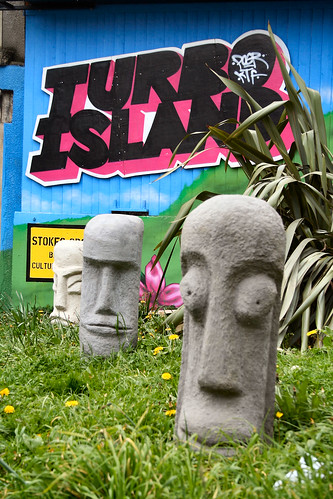
I'm looking forward to the results of the dig! Here's some pictures of Turbo Island, looks like a cool spot. This one from the Bristol Graffiti blog:

More photos here!


From Canis Major on Flickr. Love the tiny Moai! Apropos the photo Canis Major notes: "The small plot of land in Stokes Croft Bristol called Turbo Island apparently got it's name from a strong brand of cider that street drinkers who regularly met there used to favour. It has now become a focus for the area's urban artists. These Easter Island style heads being a recent addition." Mmm, some cheap strong cider sounds good right now.

06 December 2009

Rebranding Balkan Archaeology: Old Europe at NYU


Photo: Marius Amarie

Last week the New York Times profiled the blockbuster exhibition of Neolithic artifacts from the Danube Valley and environs at NYU's Institute for the Study of the Ancient World. The artifacts are stunning and I'm now trying to find an excuse to go to New York.

Photo: Rumyana Kostadinova Ivanova/NYT

This exhibit is a brilliant example of an evolving archaeological brand. Check out the title: The Lost World of Old Europe: The Danube Valley, 5000–3500 BC.

There's a lot to talk about here. First of all, they've gone with the "lost world" concept, evoking the notion of archaeologist as detective and discoverer. It's a powerful concept that evokes our desire for identity, to rediscover ourselves.1 Then we have 'Old' and 'Europe' jammed right into each other for the knockout. Especially in America, anything old has an aura of 'good' and 'authentic' about it. And the type of Americans who go to archaeology exhibits in New York have an desperate enthusiasm for Europe that sometimes verges on the pathetic.

The Lost World of Old Europe. That sounds like the most important, serious, and authentic place ever. But where is it, anyway? Hmm, the Danube Valley. Let's get out the map. Mmmm, Bulgaria, Romania, and Moldova. The proverbial ass-end of Europe, associated in western popular culture with vampires, gypsies, gangsters, cheap tracksuits, and unattractive miniature cars.

NOW you see the genius of the title. No one's going to go to an exhibit with 'Bulgaria' in the title, much less 'Moldova'2 - It's a deeply unfashionable part of Europe and not the kind of place New York Times readers go to on vacation. But Old Europe? I definitely want to go there, wherever it is. Well-placed branding makes this peripheral region suddenly central, serious, and worthy of respect.

It's fashionable to dismiss "branding" as inauthentic, but I disagree. Archaeology needs good brands and better marketing. The material in this exhibit is really amazing and deserves to generate excitement - and if good marketing slogans help do away with some of the prejudice against the poorer Balkan countries, all the better.

"Hmmm, how should we rebrand ourselves?" (NYU)

Pace Donald Rumsfeld, the concept of Old Europe has a bit of a history in itself. As far back as V. Gordon Childe it was recognized that Indo-European speakers probably came into Europe from somewhere in the Russian steppes, and mixed with or replaced a previous Neolithic population. The phrase was popularized, however, by Marija Gimbutas in the early 1980s, who used it to describe her idea that the Neolithic civilizations of Europe were egalitarian, matriarchal, Goddess-worshipping cultures - before the Indo-Europeans came along with their chariots and metal and established more centralized, hierarchical agricultural societies.3 While her portrait of a homogenous, matriarchal Old Europe isn't taken seriously by archaeologists anymore, the term has stuck around. I suspect that this exhibit will lead to its revival, especially since it's so convenient for tourist marketing. (Not coincidentally, there are links to the Romanian and Bulgarian tourism agencies on the exhibit website.)

1 As Cornelius Holtorf observed: “Archaeology is not a question of needs being fulfilled but of desires being sustained... the search for the past is at the same time the search for ourselves” (Stonehenge to Las Vegas: Archaeology as Popular Culture. Walnut Creek, CA: AltaMira Press, 2004. p.74)

2 Recall the 'Scythian Gold' touring exhibition from a few years back, which studiously avoided too much discussion of its Ukranian origins.

3 And, I might add, a perfect example of 'sustaining desire'. If you find a just, feminist, nonhierarchical society in the past, it helps inspire and legitimate those aspirations in the present. This is why a lot of pagans still read Gimbutas, though her theories have been refuted or heavily qualified by later analyses and new evidence - they want her vision, not the facts.

04 December 2009

Google Street View comes to Pompeii! Can we rebury it now?

The ruins of ancient Pompeii have hit Google Street View. This is the future of archaeology, folks: virtual walkthroughs of sites available anywhere, anytime, from anywhere in the world. It’s going to change things.

Check it out, it’s amazing.


Italy’s culture minister hopes this will boost tourism, but I hope something different: that Italy will do the politically inconvenient thing and rebury large portions of the old city. Yes, that’s right, I said it. We should record the whole city in 3D with high-resolution, multispectral imagery, then rebury most of Pompeii, with roofs over the rest.

Why? Because the remains of the ancient city are falling apart. And archaeology is destructive by nature. When you dig up a site – especially if you dig up walls made of anything but solid stone – what you find starts to deteriorate, immediately. The conservation situation at Pompeii is bad and getting worse.

It’s not for lack of expertise by the conservators – it’s just that no matter how much money you spend, walls without roofs and plaster on them are going to get damaged by exposure to the weather. The ‘pure’ thing, from the conservation perspective, is to avoid modern interventions at all costs. The only way to avoid roofing a site, and still conserve it, is reburial.

I can hear the howls already. I loved visiting the place myself. But 2.5 million visitors per year is unsustainable, and everybody knows it. If we want future generations to have anything to look at, something has to be done sooner rather than later.

My suggestion: start with street view. Add an ambient soundscape. Open it up to developers to create games and 3D reconstructions based on the archaeology of the city that people can enjoy on the interwebs. And then sell tickets to visit select areas of the site by lottery, with a drastically reduced number of visitors.

Sound harsh? Welcome to reality. If we're really thinking about conservation, we're planning for 1000 or 10,000 years. In most places, the only way to conserve a place for that long is reburial, with the occasional re-excavation as a special event. Technologies like street view are an incredible blessing for archaeology because they let excavators show off a permanent, 3D exhibition of their finds. And if you want to rebury the site, you can, while allowing the public to visit the spaces. If the recording is multi-spectral and high-resolution enough, you could do a lot of scholarship while the ruins sleep safely underground.