24 September 2009

The Staffordshire Hoard Revealed


The hoard was revealed this morning, and it's a doozy: over 1,500 items, 5 kg of gold, and 2.5 kg of silver. Metal detectorist Tony Herbert called in experts after finding the first 500 pieces, and archaeologists uncovered the rest. They suspect there may be more yet buried. The location of the find, of course, is being kept fairly tightly guarded.

The BBC article is here, along with a photo gallery. A Flickr page has over 600 photos for you serious gold geeks out there. It's stunning stuff.

Conservator's comments here and video of the excavation here, behind short ads. (BBC won't allow embedding until October.) They apparently haven't cleaned many of the objects yet, which you can see in the photographs.

You can't highlight a find like this without also talking about the UK's Portable Antiquities Scheme. The PAS is a system of voluntary reporting of archaeological finds - instead of fighting the hobbyists and metal detectorists, the government decided to recruit them to report what they found, and where. Over 140,000 objects have been recorded so far (you can see some especially interesting ones here). The project is administered by the British Museum and was fully funded in 2006.

Unlike many countries, English common law allows the finder to keep archaeological objects. What the PAS does is encourage finders to record the provenance of objects and make information about them available to the public. It has helped promote education about and public involvement in archaeology on a wide scale. Read about the history of the project here.

Finds like the Staffordshire Hoard are governed by the Treasure Act 1996, which is the exception to the common law: it requires finders of gold and silver artifacts over 300 years old to report them to the government within 14 days. Local or national museums can take possession of the objects, but they have to pay the landowner and/or discoverer the market rate for the finds.

The Hoard was declared "treasure" today by the Staffordshire Coroner, which everyone expected: the declaration was needed for the British Museum to keep the objects. Tony Herbert and the unnamed landowner, however, will split the reward for the treasure and are likely to become very rich men.

23 September 2009

The Staffordshire Hoard: Unveiling Tomorrow

According to the Beeb, a huge hoard of gold objects from the 6th to 8th centuries was found in July under a field in Staffordshire. Their ownership is yet to be decided, but in the meantime the hoard will be unveiled to the public tomorrow at the Birmingham Museum. Birminghamnewsroom.com reports:
A discovery that will redefine the Dark Ages is to be unveiled at Birmingham Museum and Art Gallery tomorrow (Sept 24).

The Staffordshire Hoard is a stunning find of Anglo-Saxon gold discovered earlier this year. It is the largest such hoard ever found and of international importance.

It will be presented for the first time during a press conference at Birmingham Museum and Art Gallery tomorrow (Sep 24) at 11.30am.

Experts will be on-hand to talk about the discovery and how it will help rewrite history. Important pieces of treasure will be on show and available to photograph.

Artefacts from the Hoard will be on display at Birmingham Museum and Art Gallery from Friday September 25.

Stay tuned for more! Hopefully there'll be juicy pictures in the press tomorrow. Any English readers who care to report from the press conference?

More Craigslist Shenanigans: Plato

Craigslist is full of treasures! Thanks go to Bruce Frier for this gem:

Autographed Copy of Plato's Republic


Date: 2008-07-09, 11:00AM CDT


1st edition of The Republic signed by its author. There is of course a reasonable amount of wear and tear, (light highlighting and underlining, dog-eared pages, back cover missing, etc.), but it is in overall good condition considering its age.

First come first serve

  • Location: chicago loop
  • it's NOT ok to contact this poster with services or other commercial interests

22 September 2009

Teaching Archaeology at Johnson's Island


Johnson's Island in Ohio was a prison camp for Confederate soldiers during the American Civil War, and has been an ongoing dig for the last 2o years or so. Archaeology Magazine has an "Interactive Dig" feature about the site, which is used as a field school and has great public outreach programs. I especially like the most recent field report, written by teachers who were learning about archaeology and developing ideas on how to present the field to young adults.

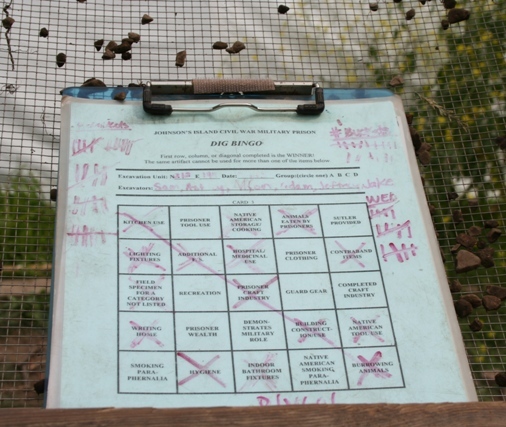
I especially like Dig Bingo, which seems like a great idea for teaching students to look for the significance of artifacts as they dig. The teachers report:
When we were first given our bingo sheet we assumed it was just the activity for the day and it would be no big deal, little did we know it wasn’t as easy as it looked! As we began digging and sifting as a team we soon realized how difficult it was going to be. Being a young competitive group we quickly learned the techniques to finding artifacts in the dirt. We were able to find pieces of chamber pots, possible tea cups, animal claws, parts of medical and relish bottles, and pottery to get our bingo. Getting bingo after three days of digging was one of the most exciting things about the week.
The Dig Bingo sheet.

Sounds like 'Interpretation at the trowel's edge' with a dash of church social thrown in!

I have a personal interest in the site: my great-great-grandfather, Austin Shoup, was posted there from August 1863 to July 1865 during his service in the 128th Ohio Volunteer Infantry. Though winter on Lake Erie is definitely unpleasant, I have admit that this is a pretty soft posting for an infantryman in 1863 - the year of Chancellorsville, Chickamauga, and Gettysburg. It's always made me a little reluctant to brag about "having an ancestor who fought in the Civil War."

31 August 2009

A Sweet Archaeology Job Posting


Well, the job market for archaeologists is certainly in the dumps, what with the recession and all. (see stories like this and this.) So it's great to see a job ad for an archaeologist on Craigslist!

Alchemical, Video, Archaeological Assistant


Date: 2009-07-13, 10:46PM PDT


The short version: we are an independent video production company, which - during the course of filming a radical new science documentary - made a series of rather incredible discoveries (and these discoveries are on-going). Our breakthroughs represent a radical new view of an esoteric world history, and resulted in equally amazing technologies. We are now preparing to market some of these.

What are these technologies?
As amazing as our answer seems, we are not exaggerating. We have rediscovered the "elixir of life," once known also as Amrita, Soma, and (through the European mythos) the "Holy Grail!" And that's not all.
...
Can you work with shop tools and wood? Do you have a background in chemistry, archaeology or biology? Do you have a familiarity with lab safety, using a microscope or with chemical reagents? A person familiar with scientific disciplines is preferable.
Hmm, I didn't do too great in my alchemy classes in grad school. I hope they'll take me anyway?

Read the rest here. This could be your (eternal) life!


22 August 2009

Scuba Diving Beneath Hagia Sophia

BLDGBLOG reports on an upcoming film that nearly makes me wet my pants with excitement:
While scuba diving beneath Hagia Sophia, an exploratory team led by filmmaker Goksel Gülensoy has "managed to reach areas that until now, no one had ever managed to reach," down there in flooded basins 1000 feet beneath Istanbul's heavily touristed religious structure.
In the process, they have discovered 800-year old submerged graves containing the remains of "canonized children."
This was just part of a larger, underwater archaeo-spatial survey:
    The divers and specialists explored the connection of the basins underneath Aghia Sophia with the aqueduct and the palace of Top Kapi. In addition they attempted to locate the secret tunnels from Tekfour Palace to the Islands.
Those "secret tunnels" are presumably the rumored subterranean extensions of the Anemas Dungeons – but who knows.
Secret tunnels from Tekfur Sarayı to the Islands? Subterranean dungeons? Sign me up!

21 August 2009

"Cave Complex Allegedly Found Under Giza Pyramids"; or, Why We Should Be Skeptical of the News Media


The Discovery Channel's website has recently posted an article about a series of caves that may exist underneath the Giza pyramids. It's hard to know where to begin with this one; it's semi-sensationalist articles like these that lead so many people to assume that the pyramid complexes contain untold mysteries and phenomena that the academic establishment is unwilling to reveal.
First, the individual who claims to have found the caves is cited as a "British explorer" - i.e., an interested amateur who may very well have fresh ideas about the nature of the Giza plateau, but who has no actual credentials for excavating there. But it's hard to determine what, exactly, he was doing on the plateau; Egypt's Supreme Council of Antiquities has very strict rules about who can excavate within Egypt, and rightly so. Long gone are the days when European adventurers ran unchecked in Egypt, sometimes dynamiting the entrance to a tomb if they so chose (something that did, in fact, happen in the 1830s). So how, exactly, did Andrew Collins manage to discover and explore these alleged subterranean caves, given that he is not a professional Egyptologist with an affiliation to an academic institution (as per SCA requirements)? The article does not ask this question; perhaps we have to wait for the inevitable tv special.

The article does state, however, that Mr. Collins was aided in his discovery by "British Egyptologist Nigel Skinner-Simpson". By his own admission, on his website, Mr. Skinner-Simpson is not an Egyptologist. He is a computer software developer who practices as an amateur in Egyptology and maintains a membership to the Egypt Exploration Society (membership is open to anyone who can pay £42 per year). This is not a trivial point that I argue: when the news media throws around the term "Egyptologist", assigning it to anyone who has a theory about Egypt, it is a gross misleading of the public. [Update: I have been kindly informed by Mr. Skinner-Simpson that the attribution to him of the title "Egyptologist" was an editorial error that they were unable to correct for publication.]

The article was relatively brief, but here are my first impressions regarding Mr. Collins' claims about his discovery. He allegedly found a massive natural cave under the Giza plateau. The pyramids were built on limestone bedrock and even incorporated some outcroppings of that bedrock into the lower body of the pyramid. I am not a geologist, but the fact that the bedrock might contain some natural caves does not strike me as necessarily problematic (though I would welcome some insight on this point from a geologist). However, this is where the article gets fuzzy; it's unclear whether Mr. Collins thinks he's found man-made tunnels and "catacombs" cut into the bedrock, or whether the alleged discovery remains simply that of natural caves. He does make clear that he believes these natural caves inspired the ancient Egyptians' beliefs in an underworld, and this is the point at which his claims become sheer speculation.

The Egyptian concept of the afterlife, and the journey to it, was exceedingly complex. The afterlife had a celestial sphere as well as a subterranean element, and it is often difficult to separate the concepts into distinct topographies; Egyptian religious and mythological concepts had a tendency to blur and blend together, built up as they were over thousands of years from disparate sources. Mr. Collins claims that the ancient name of the Giza and Memphis cemeteries, Rosetjau (meaning "entrance of the passages") is "unquestionably a reference to the entrance to a subterranean cave world, one long rumored to exist beneath the [Giza] plateau." In fact, the use of the word Rosetjau in funerary texts was not limited to referencing only the Giza necropolis specifically. According to Egyptologist John Taylor - who is the Assistant Keeper of Egyptian Antiquites at the British Museum - "The term Rosetjau denoted any hole or shaft in the ground (principally tomb shafts but also natural features) which was believed to be an entrance to the netherworld" (italics added).

In other words, Mr. Collins' speculation is interesting but so far is supported only by circumstantial evidence. And how did he obtain that evidence? You'll have to wait for his forthcoming book, apparently.