
Happy Valentine's Day from Archaeopop and Robert Browning. 'Love Among the Ruins' (1852, first published in Men and Women, 1855)Where the quiet-coloured end of evening smiles, Miles and miles On the solitary pastures where our sheep Half-asleep Tinkle homeward thro' the twilight, stray or stop As they crop-- Was the site once of a city great and gay, (So they say) Of our country's very capital, its prince Ages since Held his court in, gathered councils, wielding far Peace or war.Now the country does not even boast a tree, As you see, To distinguish slopes of verdure, certain rills From the hills Intersect and give a name to, (else they run Into one) Where the domed and daring palace shot its spires Up like fires O'er the hundred-gated circuit of a wall Bounding all Made of marble, men might march on nor be prest Twelve abreast.
14 February 2011
Love Among the Ruins


13 February 2011
Music to Dig By: Pink Floyd plays Pompeii
In October 1971, Pink Floyd recorded six songs in the amphitheater of Pompeii, without an audience. The film 'Live At Pompeii' was released in 1972 (and a director's cut in 2003).
Super epic and purely theatrical at the same time. The lack of an audience symbolizes what happened with progressive rock: the 18-minute jam became the end in itself, without the need to hold a live audience. 'Album-oriented rock' is meant to listen to at home, alone, and stoned, so you don't mind the fact that the song never ends.
Still sounds rad though. Here's 'Echoes', Part Two:
12 February 2011

11 February 2011
UFO Phil Wants to Build a Pyramid on Pike's Peak

I have to admit, Photoshop makes this idea seem almost cool.
'UFO Phil' is a comedian and writer of terrible songs about UFOs. He's been implanted with a "telepathy chip" that allows him to communicate with "Zaxon" and "Rogness", a couple of aliens from somewhere or other. Lately he's been eating out on an unlikely plan: building a replica of the Great Pyramid of Giza on top of Pike's Peak in Colorado (14,112'/4,302m). As AOL News reports, The pyramid will function as an UFO docking station. Denver's KMGH TV 7 is there with hard-hitting coverage:
Besides serving as landing stations, the pyramid will also generate free energy:
Hill alleges that the ancient Egyptian pyramids -- designed by extraterrestrials, of course -- were massive stone power stations. Through his ongoing otherworldly contacts, he's been singled out and gifted with secret blueprints and schematics. These plans, of alien design, of course, reveal how the pyramids can generate enough hydrogen gas to power everything on Earth.Apparently one alien ship brings sand, and the other brings hydrochloric acid, and they mix it in the pyramid, and it makes hydrogen, then the spaceships take it "all over the galaxy". Phil explains it to a reporter at the Colorado Springs Gazette (free energy technique at 1:52):
Dude is pretty annoying, but has some funny jokes. Building the pyramid will create jobs, since it takes so many men to lug the stones up to the top of the peak. "I can't pay them much, but I understand that was how it was done originally anyway." Priceless.
The gift shop and restaurant will be moved to a deck on the side of the pyramid.
Phil obviously came up with this pyramid thing as a media stunt to sell some songs on iTunes and turn himself into a meme. But hey, he seems to have managed it all right. In case you're not sick of this dweeb yet, he's got a facebook page, too.
09 February 2011
Three ages of denim
This month Gallery Didier Aaron in New York (didieraaron.com, via Boing Boing and NYT Magazine) is showing a newly-discovered fragment of an archaeology of daily life - an anonymous 17th century painter known as 'the Master of the Blue Jeans'. His paintings show scenes of everyday life in Italy: a barbershop, a woman sewing, a family begging, a poor child. In each one, we see a familiar blue fabric in a most unfamiliar setting.

Galerie Didier Aaron
The exhibition of seven works by this previously unknown painter was organized by Gerlinde Gruber of the Kunsthistorisches Museum in Vienna and runs in New York until February 18th. She was the one who attributed these paintings to a single artist - previously they had been attributed to a variety of other masters.
Denim is so deeply ingrained into the fabric of everyday life today (excuse the pun), that its history has been obscured. I hadn't known until today, for instance, that blue denim-like fabrics have been in use since the 14th century in Europe. The name comes from 'serge de Nîmes': it was a type of serge, or twill, made in the French city of Nimes. It was a tough material for poor people. 'Blue jeans' as a name for denim trousers seems to come from 'bleu de Genes', or 'Genoa blue', since the trousers were adopted as workwear by Genoa's navy (according to wikipedia, anyhow).

The paintings make it obvious how totally we've forgotten the early history of the fabric that rules our lives. Putting 17th century characters in denim is weird and provocative - the kind of thing you'd expect from an art student's master's thesis. Look at this kid in his thrashed, too-big denim coat. He's ruddy, a little vacant, a little fearful maybe. He looks beaten down by life, and he's probably only nine. It's radically dissonant from everything we associate with a jean jacket.
I put this dissonance down to the power of the American ideal of denim. The fabric always had totally different connotations there. Since blue jeans became the iconic look of the California gold rush, they've been associated with the frontier, with its miners and cowboys. Blue jeans were the dress of free men and adventurers - the jeans might be ragged but they say 'hard work' and 'self-sufficiency' rather than 'grinding poverty'. The paintings in the Master of the Blue Jeans exhibit not only show denim fabric, but associate it with the ragged, hunger-stalked life of the urban masses of Europe: lives of subjection to which America formed a symbolic counterpoint. They present an almost total contrast to the cowboy image.

Look at these miners: hard-working frontiersmen, not sad-eyed beggars (The Fashionary)
In the 1980s we started the third age of denim: thanks to the Hollywood-industrial complex the fabric of working men, greasers, and hippies has become a massive, globalized business that dresses billions. For the first time, we no longer pretend that denim is workwear, or supposed to be cheap. Try finding a decent pair of jeans for under $60 (I recommend 511s)! In a lot of places, wearing jeans is a mark that you've emerged from developing country gloom and joined the global society: check out, for instance, Levi's new China-focused branding and marketing efforts. Rather than signaling poverty, donning denim is now a marker of its opposite. An object lesson in the mutability of material culture, and a good reminder for the archaeologist that the meaning of objects is never fixed.

Look, they're wearing denim. But are they European beggars, or gold miners? I'm confused.
Some extra links:
More denim history is here.
Fawning yet nonetheless interesting microhistories of many luxury denim brands at Denimblog.
See the 100-year old pair of Levi's discovered in the Nevada desert.

Galerie Didier Aaron
The exhibition of seven works by this previously unknown painter was organized by Gerlinde Gruber of the Kunsthistorisches Museum in Vienna and runs in New York until February 18th. She was the one who attributed these paintings to a single artist - previously they had been attributed to a variety of other masters.
Denim is so deeply ingrained into the fabric of everyday life today (excuse the pun), that its history has been obscured. I hadn't known until today, for instance, that blue denim-like fabrics have been in use since the 14th century in Europe. The name comes from 'serge de Nîmes': it was a type of serge, or twill, made in the French city of Nimes. It was a tough material for poor people. 'Blue jeans' as a name for denim trousers seems to come from 'bleu de Genes', or 'Genoa blue', since the trousers were adopted as workwear by Genoa's navy (according to wikipedia, anyhow).

The paintings make it obvious how totally we've forgotten the early history of the fabric that rules our lives. Putting 17th century characters in denim is weird and provocative - the kind of thing you'd expect from an art student's master's thesis. Look at this kid in his thrashed, too-big denim coat. He's ruddy, a little vacant, a little fearful maybe. He looks beaten down by life, and he's probably only nine. It's radically dissonant from everything we associate with a jean jacket.
I put this dissonance down to the power of the American ideal of denim. The fabric always had totally different connotations there. Since blue jeans became the iconic look of the California gold rush, they've been associated with the frontier, with its miners and cowboys. Blue jeans were the dress of free men and adventurers - the jeans might be ragged but they say 'hard work' and 'self-sufficiency' rather than 'grinding poverty'. The paintings in the Master of the Blue Jeans exhibit not only show denim fabric, but associate it with the ragged, hunger-stalked life of the urban masses of Europe: lives of subjection to which America formed a symbolic counterpoint. They present an almost total contrast to the cowboy image.
Look at these miners: hard-working frontiersmen, not sad-eyed beggars (The Fashionary)
In the 1980s we started the third age of denim: thanks to the Hollywood-industrial complex the fabric of working men, greasers, and hippies has become a massive, globalized business that dresses billions. For the first time, we no longer pretend that denim is workwear, or supposed to be cheap. Try finding a decent pair of jeans for under $60 (I recommend 511s)! In a lot of places, wearing jeans is a mark that you've emerged from developing country gloom and joined the global society: check out, for instance, Levi's new China-focused branding and marketing efforts. Rather than signaling poverty, donning denim is now a marker of its opposite. An object lesson in the mutability of material culture, and a good reminder for the archaeologist that the meaning of objects is never fixed.

Look, they're wearing denim. But are they European beggars, or gold miners? I'm confused.
Some extra links:
More denim history is here.
Fawning yet nonetheless interesting microhistories of many luxury denim brands at Denimblog.
See the 100-year old pair of Levi's discovered in the Nevada desert.
02 February 2011
Tracking the Looting in Egypt

A decapitated mummy in the Egyptian Museum (National Geographic)
If you can spare an eye from Al Jazeera's live feed from Cairo, I want to recommend two sites tracking what we know about looting of museums and sites since the protests began in Egypt last week:
- Kate Phizackerley's (her real name!) Egyptological Looting Database covers sites around the country
- Egyptologist Margaret Maitland's Eloquent Peasant, which has a good link, video, and photo roundup updated today.

Standing guard (National Geographic).
In the fuss about the attack on the Egyptian Museum (which seems to have been orchestrated by the police for propaganda value), I hadn't heard about the thefts from less-known depots and sites (Qantara, the Coptic Museum in Cairo, Memphis, Herakleopolis Magna, Saqqara, Giza), though some of them are rumors as yet without any hard data. Let's hope that Zahi is right, and everything remains under lock and key. And props to all of the demonstrators who formed that human chain in front of the Egyptian Museum.

Nat Geo has a good article on how bloggers and ordinary people are pitching in to protect museums and recover stolen artifacts, and a good summary of the museum attack (dated Sunday), including this video:
29 January 2011
De-moralizing climate change: archaeology and the terraforming of earth
This month three major studies on historical climate change have hit the press. They all seem like great pieces of research and could help us rethink our twisted, overly moralistic approaches to dealing with the global climate change that is now in progress.

Model of a Roman grain ship (right). These babies made the Empire go 'round (Hotz Artworks)
The other two publications help us understand how complicated the story actually is. Researchers from Lausanne have created a climate model of the last 8,000 years that suggests that humans have been modifying the earth’s climate for at least that long, beginning with deforestation connected to the introduction of farming and the Neolithic revolution. The data show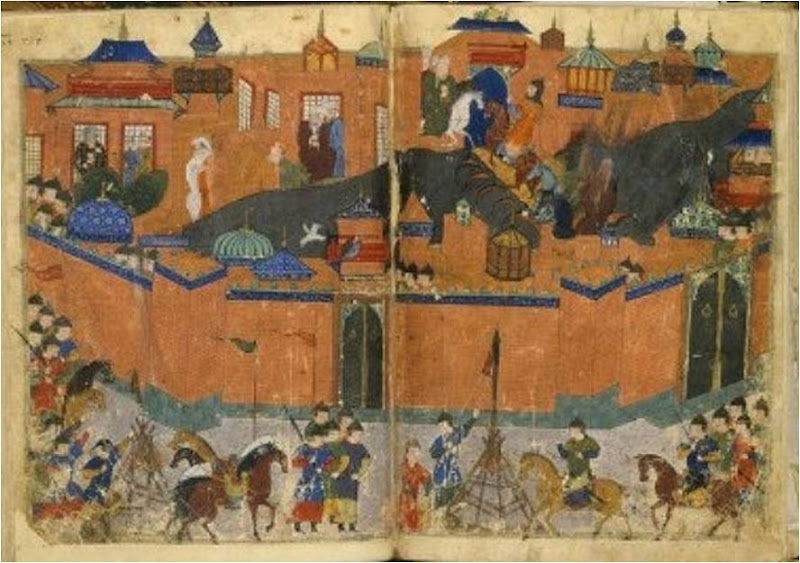
Hulagu takes Baghdad (Wikimedia)
Of course, killing all those people means massive reforestation for a couple centuries, which takes a huge amount of carbon out of the atmosphere. Unfortunately the environmentalists’ tendency to treat carbon dioxide as an immoral substance lends a kind of triumphal air to discussion of genocide.
To be fair, the research itself (by scholars from the Carnegie Institution and the Max Planck Institute) seems sound and makes the important point, along with the other two studies above, that people’s actions affect the environment just as much as the environment affects us. It’s a complex relationship that can’t be reduced to simple platitudes like ‘climate change caused the fall of the Roman Empire’.
Understanding this dynamic is important. The debate about climate change has been immature and moralistic in a really counterproductive way. “The environment” is presented as a monolithic, passive thing that corrupt humans are “destroying” with their evil actions. This view flows directly from Christian mythology about original sin (the corrupt nature of humanity) and the Fall from Eden.
These myths have a deep emotional resonance for people of European-Christian cultural backgrounds but are a stupid – and misanthropist - way to approach climate change. If people are evil and reducing carbon dioxide is good, then one starts to flirt with genocide as a ‘moral solution’ to our ‘climate problem’. And indeed, some strains of Deep Ecology and ecological anarchist philosophy make exactly this point. Primitivist anarchists, like John Zerzan even go so far as to imply that language and symbolic thought are the origin of human “crimes against nature”, with the implication that the only way to “save the earth” is for us all to die, or stop being human. Despite the obvious self-hatred and borderline insanity contained in these ideas, they are extremely influential on the way people think about the environment in Western countries today.

John Zerzan's utopia: back to caveman grunts (image by SEAN)
Good archaeological and ecological research have an important role to play in countering this stupidity, and (if I may be so bold), redeeming humanity. The research above shows that as long as there have been humans, we have influenced the Earth’s climate and ecosystem. Human history has been one big terraforming project, and no ecosystem on the planet has been unaffected by human activities. In fact, many landscapes we revere as ‘pristine’ are actually the product of human interventions. Even that darling of conservationists, the Amazonian rainforest, may be anthropogenic: huge areas of human-created soils left by much larger pre-Columbian populations nourish the primary forests we seek to preserve today. Let that sink in for a second: your biodiversity hotspot is an ecosystem that was created in concert with humans.

Terra Preta, Brazil (Philip Coppens)
This story of human omnipresence in ancient ecosystems can be told about many places. I myself remember hiking up to a remote pass in the John Muir Wilderness – a zone legally off-limits to most human activities – and finding a giant scatter of flaked obsidian, remnants of a trading zone where people from the eastern side of the mountains came to trade good-quality stone for goods from the western side. That isolated, rugged place, marked off in our contemporary rhetoric of nature as ‘holy’, ‘untouched’, and ‘pristine’, had been a lively summer trading center some hundreds of years before. For me, it made it more beautiful to know that people had been there before, that the place had functioned as part of a social system as well as an ecosystem.
The fact is, we have coevolved with our home planet. It’s time to get over the idea that there is any ‘nature’ separate from ‘culture’. Archaeological evidence shows that humans are an integral part of Earth’s ecosystem and have been for a long time - and we will continue to be until we go extinct. The research also shows that stable climates make it easier to create stable and prosperous human societies. The question then becomes not ‘how do we stop hurting the earth’, but ‘how do we manage the climate for stability’? If we stop treating carbon dioxide like a new age Satan – invisible, omnipresent, fed by our sins – we improve the prospects for making progress on the real threat of climate instability. It's not a question of "saving the earth" (the earth would do just fine without humans) but of saving ourselves.
The most widely circulated was the work of a German-Swiss-Austrian-American team, who created a record of Europe’s summer climates for the last 2,500 years from tree-ring data. The database itself is a major accomplishment: they assembled over 9,000 samples to build the longest and most comprehensive dendrochrological record to date. (The process is fascinating - since Europe has no 2,500-year old trees, you have to find overlaps between rings in many different samples.)

Sampling a tree (Dendrodan)

Model of a Roman grain ship (right). These babies made the Empire go 'round (Hotz Artworks)
The other two publications help us understand how complicated the story actually is. Researchers from Lausanne have created a climate model of the last 8,000 years that suggests that humans have been modifying the earth’s climate for at least that long, beginning with deforestation connected to the introduction of farming and the Neolithic revolution. The data show
a first major boom in carbon emissions already 2000 years before our era, corresponding to the expansion of civilizations in China and around the mediterranean.Deforestation reduces the absorption of carbon in the atmosphere, burning wood adds it, and farming releases yet more stored in the soil - thus a big bump in atmospheric CO2, even without petroleum. It’s not entirely a one-way street, though: a significant decrease in global emissions began in the late 16th century, leading to a colder period in the 1700s and 1800s. Jed Kaplan, one of the researchers, speculates that this cold snap was connected to the destruction of Native populations of eastern North America by disease (at least 80% of the indigenous population of the Americas died between 1492 and 1650), leading to a swift reforestation of large areas of the continent and a reduction of atmospheric CO2. The sophisticated agricultural cultures of eastern North America used land a lot more intensively, and cleared more forest, than we learned about in school – something to think about the next time you have a fit of romantic yearning for a pure, ‘sustainable’, 'indigenous' lifestyle. So what we see here is a more complicated relationship: people affected climate, and climate affected people, often in unpredictable ways. If Kaplan is right, you could say that for a minute, smallpox played a major role in regulating atmospheric CO2. It’s a depressing but accurate point: mass death reduces greenhouse gas emissions. Which brings me to the last of the three studies, reported with one of the most disgusting headlines I’ve ever read:
“Was Genghis Khan history’s greenest conqueror? The Mongol invasions scrubbed nearly 700 million tons of carbon from the atmosphere, according to surprising new research”Aside from the science, such unbelievably idiotic rhetoric is why a lot of people hate environmentalists (though this ‘Mother Nature Network’ outfit, funded by Coca-Cola, General Electric, Coors, and Georgia-Pacific, seems like a disinformation operation to me). Genghis Khan and his predecessors destroyed a number of civilizations and killed (after raping and torturing) something like 40,000,000 people. Hulagu Khan’s gory destruction of Baghdad in 1258 was the worst thing to happen there until the recent American invasion.
Hulagu takes Baghdad (Wikimedia)
Of course, killing all those people means massive reforestation for a couple centuries, which takes a huge amount of carbon out of the atmosphere. Unfortunately the environmentalists’ tendency to treat carbon dioxide as an immoral substance lends a kind of triumphal air to discussion of genocide.
To be fair, the research itself (by scholars from the Carnegie Institution and the Max Planck Institute) seems sound and makes the important point, along with the other two studies above, that people’s actions affect the environment just as much as the environment affects us. It’s a complex relationship that can’t be reduced to simple platitudes like ‘climate change caused the fall of the Roman Empire’.
Understanding this dynamic is important. The debate about climate change has been immature and moralistic in a really counterproductive way. “The environment” is presented as a monolithic, passive thing that corrupt humans are “destroying” with their evil actions. This view flows directly from Christian mythology about original sin (the corrupt nature of humanity) and the Fall from Eden.
These myths have a deep emotional resonance for people of European-Christian cultural backgrounds but are a stupid – and misanthropist - way to approach climate change. If people are evil and reducing carbon dioxide is good, then one starts to flirt with genocide as a ‘moral solution’ to our ‘climate problem’. And indeed, some strains of Deep Ecology and ecological anarchist philosophy make exactly this point. Primitivist anarchists, like John Zerzan even go so far as to imply that language and symbolic thought are the origin of human “crimes against nature”, with the implication that the only way to “save the earth” is for us all to die, or stop being human. Despite the obvious self-hatred and borderline insanity contained in these ideas, they are extremely influential on the way people think about the environment in Western countries today.

John Zerzan's utopia: back to caveman grunts (image by SEAN)
Good archaeological and ecological research have an important role to play in countering this stupidity, and (if I may be so bold), redeeming humanity. The research above shows that as long as there have been humans, we have influenced the Earth’s climate and ecosystem. Human history has been one big terraforming project, and no ecosystem on the planet has been unaffected by human activities. In fact, many landscapes we revere as ‘pristine’ are actually the product of human interventions. Even that darling of conservationists, the Amazonian rainforest, may be anthropogenic: huge areas of human-created soils left by much larger pre-Columbian populations nourish the primary forests we seek to preserve today. Let that sink in for a second: your biodiversity hotspot is an ecosystem that was created in concert with humans.

Terra Preta, Brazil (Philip Coppens)
This story of human omnipresence in ancient ecosystems can be told about many places. I myself remember hiking up to a remote pass in the John Muir Wilderness – a zone legally off-limits to most human activities – and finding a giant scatter of flaked obsidian, remnants of a trading zone where people from the eastern side of the mountains came to trade good-quality stone for goods from the western side. That isolated, rugged place, marked off in our contemporary rhetoric of nature as ‘holy’, ‘untouched’, and ‘pristine’, had been a lively summer trading center some hundreds of years before. For me, it made it more beautiful to know that people had been there before, that the place had functioned as part of a social system as well as an ecosystem.
The fact is, we have coevolved with our home planet. It’s time to get over the idea that there is any ‘nature’ separate from ‘culture’. Archaeological evidence shows that humans are an integral part of Earth’s ecosystem and have been for a long time - and we will continue to be until we go extinct. The research also shows that stable climates make it easier to create stable and prosperous human societies. The question then becomes not ‘how do we stop hurting the earth’, but ‘how do we manage the climate for stability’? If we stop treating carbon dioxide like a new age Satan – invisible, omnipresent, fed by our sins – we improve the prospects for making progress on the real threat of climate instability. It's not a question of "saving the earth" (the earth would do just fine without humans) but of saving ourselves.
Subscribe to:
Posts (Atom)


